
Last updated
Swarmia, dancing bees & other notes
It’s been a few weeks now since I joined Swarmia. I’m learning to hear the difference between Mika and Miikka and I absentmindedly practice saying Otto the Finnish way at least 10 times a day but I don’t think I have it quite right yet.
These are the things I am focusing on because the job itself is like I have always had this job, or at least like I have always been headed toward this job, even though I spent most of my first two weeks working with sales and marketing people, even though my only PR has been to add my picture to the website, which is a thing you do when things are this small. I’m writing some blog posts, including one about how a company’s productivity journey is heavily influenced by its size, age, and culture.
I’m thinking about some talks I could give, and I’m starting a podcast? You heard it here first.
I promised you bees #
When you work for a company called Swarmia you end up thinking about bees (or locusts, I guess) perhaps more than the median person. So far I’m sticking with bees.
Anyway, a few clicks after thinking “BEES,” I was reading about the Waggle Dance. I was vaguely aware of the waggle dance before today, but I didn’t know that honeybees arrive at the correct decision essentially via consensus. Not just that, but bees perform communal risk/benefit analysis to avoid ending up dead? From the wikipedia page linked above:
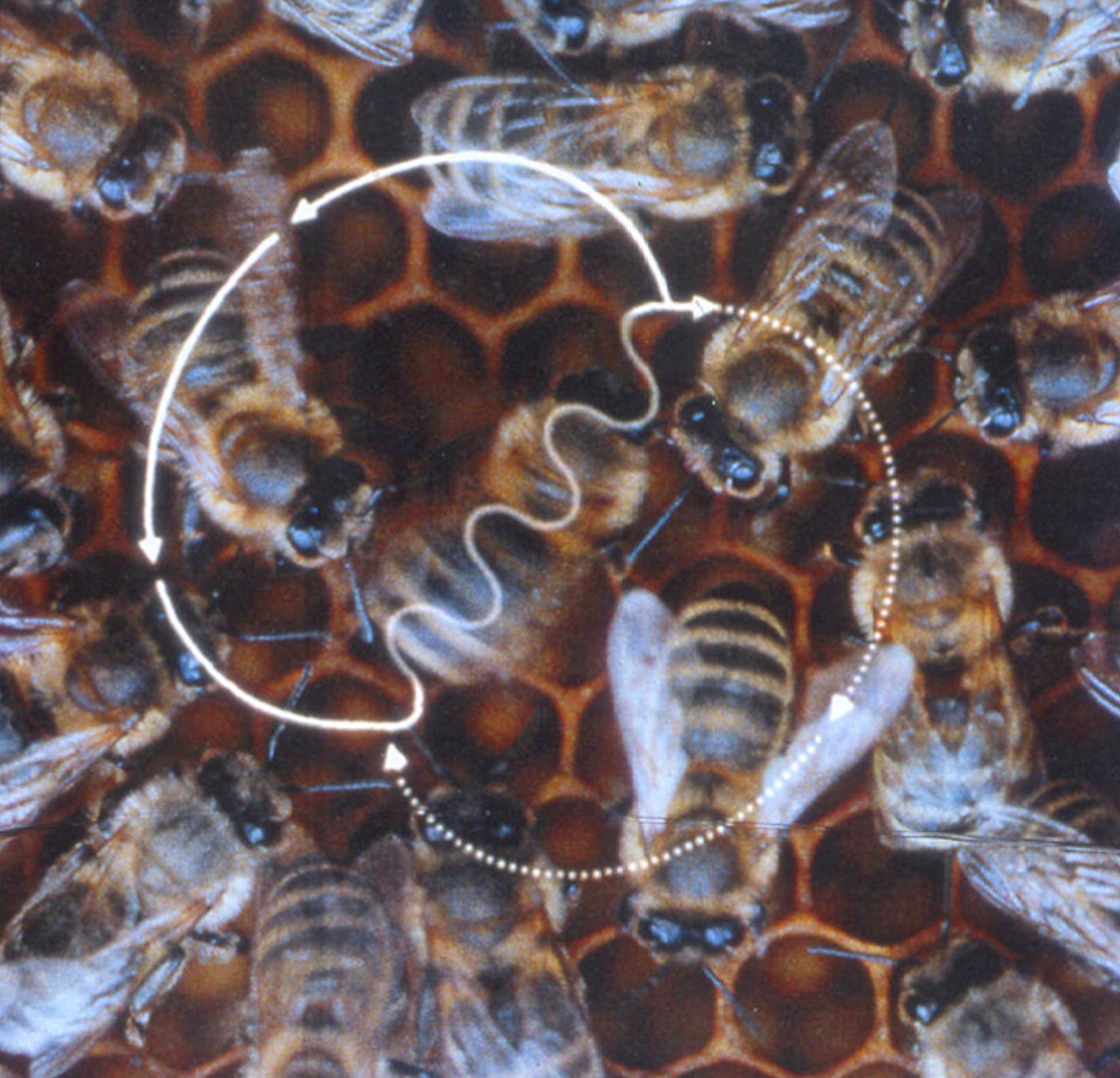
(Figure design: J. Tautz and M. Kleinhenz, Beegroup Würzburg.) Chittka L: Dances as Windows into Insect Perception. PLoS Biol 2/7/2004: e216. https://dx.doi.org/10.1371/journal.pbio.0020216
[I]f a dead western honeybee is placed on a flower, bees performed far fewer waggle dances upon returning to the hive. The scientists explain that the bees associate the dead bee with the presence of a predator at the food source. The reduction of the dance repetition frequency, therefore, indicates that the dancing bees perform and communicate a form of risk/benefit analysis.
This has me thinking about a lot of things:
-
Bees can literally align other bees toward a goal. This works if the bees receiving message haven’t seen the outside for a while; this works (clearly a bug in the system) when you pass the message to some bees, relocate those bees, and watch where they go: regardless, the bees will orient themselves to the sun, and carry out the instructions.
-
A group of bees ready to eat learns from the bees who came back from The Outside. The hungry bees respond individually to the news from outside, in a way that manifests as collaboration without requiring agreement among the hungry bees.
-
A dancing bee can attempt to influence the other bees, but their message only carries weight if enough other dancing bees do the same dance. The collection of agreeing bees speaks louder than any single bee, and influences the hungry bees who will come back (or not) and tell their own story.
Bees, man. We could learn a lot from them, is all I’m saying.
Odds & Ends #
🌀🗞 The FLUX Review, Ep. 85 — 🌀🗞 The FLUX Review
The FLUX Review continues to be a consistently good read, and this was a gem from a recent issue:
Also on my mind:
-
I watched the Super Bowl with my nine-year-old. My favorite part was when five men had to try to explain what they’d just seen at the halftime show, but also trying to explain to the kid that this never would have made it to TV when I was nine.
-
You’ve probably read the HBR article about what’s wrong with layoffs, but if not you should. wrote about engineering culture at traditional vs SV-styled companies back in September 2022. I’m almost literally holding my breath to see whether we’re about to see a more autonomous culture creep into less SV-style companies as software engineers shuffle, whether we’re about to see the industry dismiss that approach based on recent bigco outcomes, or some third thing.
This post first appeared on my Substack, where you can subscribe for new posts.
Read more posts in the archive.