
Last updated
January 2026, Part 2: The rising tide that lifts some boats
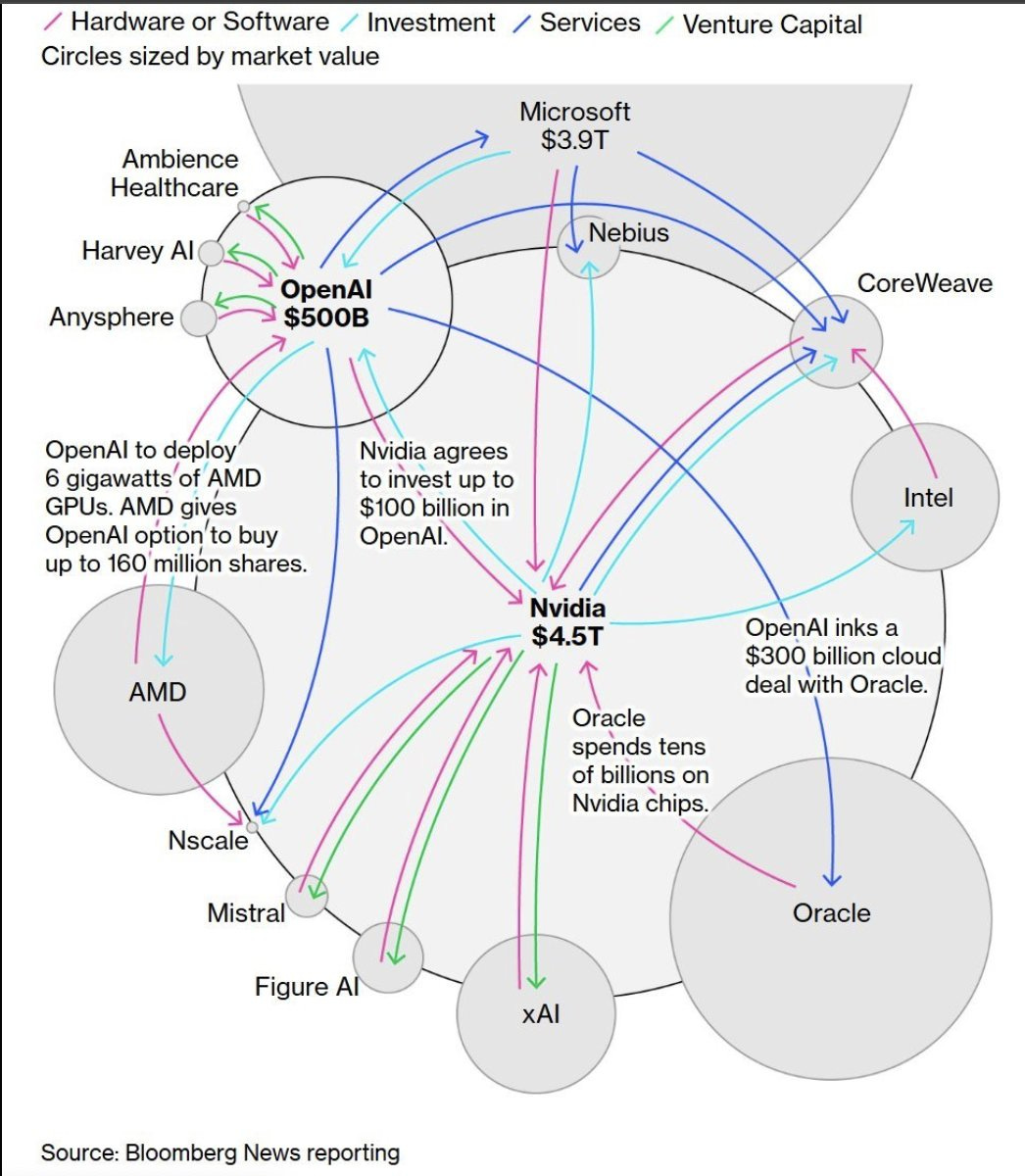
You’ve seen the Bloomberg diagram, right? Billions of dollars circulating in a tight loop, with a suspicious point in the middle, kind of like a pyramid but strictly speaking a cone. Nvidia, OpenAI, Microsoft, Oracle, AMD — all investing in and buying from each other. A striking share of the momentum is … how would you say it, circular.
Value is making its way into the broader economy, just not as fast or as evenly as the headlines might suggest. Engineers say AI makes their work feel smoother, but key delivery metrics — lead time, deployment frequency, stability — haven’t moved dramatically. The impact so far is more ergonomic than systemic. Nothing against ergonomics, just: no one thought they were buying ergonomics when they bought AI.
The real goal has always been better business outcomes, right? I mean, we did have a goal when we started all this, right? Right … ?
Well, here we are anyway, with $200/month hammers and we’re on a nail hunt. Organizations that want to turn that expensive hammer — nevermind if they’re paying per whack! — into sustained performance will be at the mercy of foundations many of them don’t have.
The illusion of cheap abundance #
Hyperscalers and venture investors are underwriting the true costs of compute, power, and infrastructure to capture market and mind share. Token prices are low partly because of genuine efficiency gains but also because someone else is paying part of the difference.
At the infrastructure layer, costs keep climbing. Said hyperscalers are spending tens of billions to build and power new data centers in anticipation of future demand.
So while API sticker prices may look flat, or even fall for smaller models, that stability masks a more complex situation: the cost to deliver AI keeps rising even as the cost to use it appears steady, and that dynamic can’t last forever.
Consider also Jevons’ paradox: when something desirable becomes cheaper or more efficient, we often use more of it — sometimes much more. The increased use offsets any efficiency gain.
AI fits perfectly into this pattern. Code generation feels “cheap,” experiments feel “free,” spinning up agents feels like low-stakes exploration. Without discipline, any efficiency gain in a desirable resource — cloud, automation, microservices, AI, another lane on a highway — will drive up total consumption of the resource. The costs show up in larger, more complex codebases; more partially completed initiatives; higher operational overhead; and a larger surface area for incidents and regressions.
As capital gets more expensive, those quiet costs stop being invisible. Finance will ask: “What did we get for this spend?” AI makes these questions more urgent. It does not make them new.
A coming divide #
The 2025 DORA report identified seven archetypes of engineering organizations. Four of them — Foundational Challenges, Legacy Bottleneck, Constrained by Process, and High Impact Low Cadence — lack the core capabilities required for AI to generate business value. Together, they represent 45% of teams.
We’re headed toward an era of AI haves and have-nots, though the lines may not fall where you’d expect.
The haves aren’t just companies with enough capital. They’re the ones with clean systems, reliable data, strong feedback loops, and engineering cultures that can actually integrate new tools and capabilities into how work gets done. They’re already getting real value from AI — incremental, but real — and for now, they’re doing it at a discount.
The have-nots are still spending disproportionately on technical debt, manual processes, and unclear ownership. For them, AI is harder to integrate, more costly to operate, and less likely to show up in the metrics that matter.
The divide isn’t between established companies and startups — some of the worst foundations exist in organizations that had fifteen years to accumulate debt and never paid it down. Newer companies that built with discipline from the start may actually be better positioned.
Over the next few years, the gap will likely widen. The benefits that currently feel broadly available will end up concentrated among those who were ready for them.
Cost, maturity, and the narrowing window #
The cost of delivering AI — powering it, maintaining it, securing it — keeps rising. The cost of using AI looks steady on paper. And building the systems and practices that let AI actually deliver value? That takes years.
If you’ve already been investing in measurement, automation, and continuous improvement, you’re positioned to keep pulling ahead. If you haven’t, the economics of AI adoption may get harder over time, not easier — though this isn’t inevitable. AI might eventually get good enough to help build the very foundations it currently requires.
Many engineering organizations are now facing the consequences of decisions made years ago. The capabilities AI relies on (good architecture, strong testing, robust automation, reliable data, psychological safety for experimentation) have always mattered. But in a world without AI, teams could compensate for gaps with human effort: late nights, manual checks, heroic debugging. That worked when compute and complexity moved slowly.
That workaround doesn’t scale with AI. AI works best with consistent interfaces, clear ownership, high-quality feedback loops. If you underinvested in these areas, realizing value on a useful timeline becomes harder. Not because you lack talent or will, but because the scaffolding isn’t there.
You can absolutely catch up. But catching up now likely requires sustained, systems-level investment at the expense of work you’d rather be doing.
What even the winners get wrong #
Even the current winners are operating on borrowed economics. OpenAI projects $9 billion in losses for 2025, spending more than 100% of revenue on compute. AI-native startups have built impressive products with small teams and generous compute credits, but the unit economics are brutal.
When subsidies fade and compute prices normalize, margins will tighten. Distinctive features will get absorbed into the platform layer of the vendors they depend on — OpenAI’s “company knowledge” now targets the enterprise search market Glean spent years building; ChatGPT search competes directly with Perplexity; and Jasper’s AI content tools look less differentiated every time Claude or GPT gets better at writing. Markets settle after a hype collapse, and I suspect we’re getting close to that “after” this year, maybe even in H1.
But certain tools are sticky.
Excel runs a terrifying amount of enterprise process, because it’s available. For certain roles, even browser-based AI like ChatGPT unlocks a sort of “automation” previously only available via Excel — even if an engineer might not call it that. I’m also optimistic about tools that make it easy to generate simple, personal apps — just maybe don’t do it and then believe you have a capital p Product.
Many people who experience reduced friction don’t really want to go back. Coding, writing, analysis — they often feel better with an AI buddy in the loop. Not universally, of course. Some developers find AI assistants interruptive, or find that reviewing AI output eats the time it supposedly saves. But for enough people, in enough contexts, AI will become a baseline expectation in their tool stack. Not because it always drives measurable improvement, but because it changes how the work feels.
A mirror, not a miracle #
For software development writ large, AI can be transforming, but it’s always revealing. It shows you how your organization actually works — unreliable data, brittle processes, teams that depend on heroics instead of systems. That’s the opportunity: treat AI as a mirror, and use what it shows you to fix your underlying problems.
The organizations getting the most from AI aren’t the ones with the biggest budgets or the fastest adoption. They’re the ones that were already investing in the fundamentals — clear ownership, reliable feedback loops, sustainable pace. AI didn’t make those things matter. It just made the gap between who has them and who doesn’t more visible.
How all of this affects the engineering workforce is still TBD. Plenty of companies are betting on more AI and fewer people right now — or cutting headcount to fund enormous AI spend. I talk to mature companies that are still investing in juniors, but it’s nothing like the late 2010s. The rolls of unemployed new grads are real.
If you’re in the 45% without those foundations, you can catch up. But the window is narrowing, and the work is the same work it’s always been: fix the systems, invest in the practices, build for durability. AI doesn’t change the prescription. It just raises the stakes.
AI is a rising tide. It’s just not going to lift all boats.
This post first appeared on my Substack, where you can subscribe for new posts.
Read more posts in the archive.